Engineered Hardwood Floors: Separating Fact from Fiction
Summary
- Engineered hardwood is real wood — a hardwood veneer over a stable plywood, slat, or HDF core
- Quality brands like Mirage, Vintage, Dubeau, Denali, and Mullican are built to last decades
- It can be sanded and refinished (sometimes multiple times)
- It can be installed in more places than solid hardwood — including over radiant heat and on concrete
- It's often more dimensionally stable than solid wood, especially in Maine's climate
- It comes in wider planks, longer boards, and more species and finish options than ever before
- If you've written off engineered hardwood, it's worth a second look.

The truth about engineered hardwood — quality, durability, and why the bad reputation is outdated
The Reputation Problem: Where Did This Myth Come From?
Ask most homeowners what they think of engineered hardwood floors and you'll hear the same things: "Isn't that the cheap stuff?" or "Won't that fall apart in a few years?"
It's a frustrating misconception — and it's been around long enough that even some experienced contractors still carry it. The confusion is understandable. In the early days of the product, there was a lot of low-quality engineered flooring on the market. Thin veneer layers, unstable cores, finishes that didn't hold up. That reputation stuck.
But the category has changed dramatically. Today, the best engineered hardwood floors are engineered specifically because of the advantages that construction provides — not as a cost-cutting measure. If we're truly comparing apples to apples — same species, same grade, same width, and same sanding surface — engineered is the superior product.
At Independence Flooring & Supply in Westbrook, Maine, this is one of the most common conversations our team has — with homeowners, interior designers, and yes, even veteran flooring installers who've been in the trade for decades. The question of which is better always gets asked. The answer always comes back to the same things: how was the lumber dried, how was the veneer cut, what is the veneer attached to, and who made it?
What "Engineered" Actually Means
Before busting myths, it helps to understand what engineered hardwood actually is.
Engineered hardwood is a multi-layer flooring product. The top layer — called the wear layer or veneer — is real hardwood. It's the same species, the same grain, the same look and feel as solid hardwood. Beneath it are multiple layers of veneers (plywood) or high-density fiberboard (HDF) arranged in a cross-ply pattern, which gives the plank its stability.
That layered core is the key. Wood expands and contracts with changes in humidity and temperature. A solid hardwood plank can only expand and contract in one direction. The cross-ply construction in engineered hardwood resists that movement in multiple directions — making it dramatically more stable in real-world conditions.
In Maine, where humidity swings between seasons can be significant, this isn't a minor detail. It's often the deciding factor.
Myth #1: "Engineered Wood Isn't Real Wood"
This might be the most widespread misconception of all — and it almost certainly traces back to products like early-generation Pergo laminate flooring.
Laminate is not wood. It's a photograph of wood printed on a composite core with a plastic wear layer on top. Engineered hardwood is something entirely different: the wear layer is actual hardwood — real wood, real grain, real species. You're walking on the same material you'd be walking on with solid hardwood. The difference is what's underneath it, and that difference works in your favor.
Engineered hardwood and laminate are no more alike than a steak and a photograph of a steak.
Myth #2: "Engineered Hardwood Can't Be Refinished"
This is probably the second most persistent misconception — and it traces directly back to those early low-quality products, which did have veneer layers too thin to sand (0.5mm–1.5mm).
Quality engineered hardwood today is a different story. Mirage Floors, one of the premier brands carried at Independence Flooring & Supply, produces engineered hardwood with wear layers thick enough to sand and refinish multiple times over the life of the floor — similar to what you'd expect from solid hardwood.
Brands like Denali, Dubeau, and Mullican also manufacture engineered lines with substantial wear layers designed for long-term refinishability. The question to ask isn't "can engineered hardwood be refinished?" — it's "how thick is the wear layer on this specific product?" That's exactly the kind of question the team at IF&S gets into with every customer.
Myth #3: "It Looks Cheap"
Walk into the Independence Flooring & Supply showroom and spend five minutes with the Mirage display. Then tell us it looks cheap.
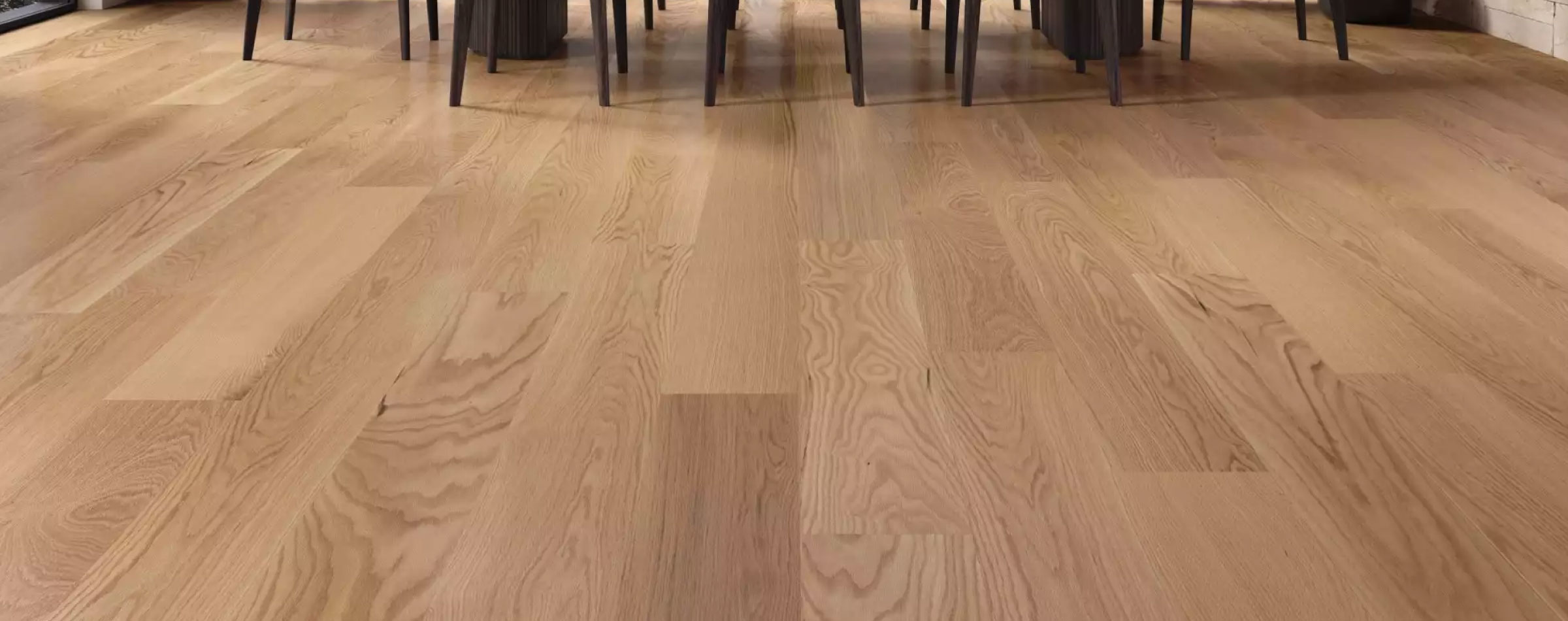
Mirage is a Canadian manufacturer that has spent decades perfecting both the engineering and the aesthetics of hardwood flooring. Their standard line goes up to 7¾ inches wide, and their Opulence collection pushes that even further — into territory that simply isn't achievable with solid hardwood without serious risk of gapping and movement.
Here's something worth thinking about: a traditional solid hardwood floor at 7 inches wide is a random-length product — boards ranging from 1 to 7 feet long. Picture what those 1-foot-by-7-inch pieces actually look like in a floor. Now picture a 7-inch engineered plank in longer, consistent lengths. The visual difference is significant. Engineered's dimensional stability is precisely what makes those wider, longer formats possible.
Vintage Hardwood Flooring and Spec Living offer distinctive character grades and wide-plank formats designed to achieve that high-end, architectural look — the kind you see in custom homes and commercial spaces.
If anything, the engineered format has expanded what's visually possible in hardwood flooring.
Myth #4: "It Won't Last"
Longevity in a hardwood floor comes down to three things: the quality of the materials, the quality of the installation, and how well it's maintained.
On materials: Mirage's engineered hardwood is manufactured in Saint-Georges, Quebec, under tight quality controls with finish coatings tested for residential and commercial durability. These aren't floors designed to last five years. A properly made and properly maintained engineered floor should last 75 to 100 years — often outlasting the renovation cycle of the home entirely.
On installation: Engineered hardwood is actually more forgiving to install correctly because of its dimensional stability. Fewer gaps. Less seasonal movement. Less risk of cupping or crowning in fluctuating humidity. These problems can still occur, but unlike solid hardwood — which needs to be maintained between 35%–55% relative humidity — most quality engineered floors open that window to 25%–70%. In Maine's climate, that's a meaningful advantage.
On maintenance: The same rules apply as solid hardwood. Keep it clean, manage moisture, use felt pads on furniture, and refinish when the wear layer calls for it. Treated right, quality engineered hardwood goes the distance.
Where Engineered Hardwood Has a Real Advantage
Here's where engineered hardwood doesn't just match solid hardwood — it outperforms it:
Floating installation. Engineered hardwood can be installed as a floating floor, meaning it isn't glued or nailed to the subfloor. This makes it an excellent option for finished basements, renovations where you don't want to disturb the subfloor, and commercial applications where flexibility matters.
Concrete subfloors. Solid hardwood generally can't be installed directly over concrete. Most engineered hardwood can — glued down or floated — which opens up a huge range of applications that would otherwise require a different flooring category entirely. (Note: hickory is an exception and generally shouldn't be installed over concrete.)
Radiant heat compatibility. This is a big one. Solid hardwood and radiant heat are a difficult combination. The dry heat causes solid wood to shrink, gap, and sometimes cup. Engineered hardwood's cross-ply construction handles radiant heat systems far better, making it a natural fit for the growing number of homes and businesses using in-floor heating.
So Why Does the Myth Persist?
Because not all engineered hardwood is the same — and the gap between the best and the worst is enormous.
Walk into a big-box home improvement store and you'll find engineered flooring at $2.99 per square foot. The reality of that product? It typically can't be refinished at all. When it's worn out in 10 to 15 years, the entire floor needs to be replaced. That's not a floor — that's a temporary surface. And unfortunately, it's what a lot of people picture when they hear "engineered hardwood."
Walk into Independence Flooring & Supply and the conversation is completely different. The team has seen virtually every product on the market. We know which brands engineer their floors to last generations and which are cutting corners. That knowledge is available to every customer who walks through the door or picks up the phone — whether you're a homeowner planning a single room remodel or a contractor pricing out a 10,000 square foot commercial job.
The Bottom Line
Engineered hardwood, done right, is a premium flooring product. It installs in more places, handles more environments, and offers more design flexibility than solid hardwood — without sacrificing the look, feel, or longevity that makes hardwood flooring worth the investment in the first place.
The key words are done right — right manufacturer, right product for the application, right installation.